
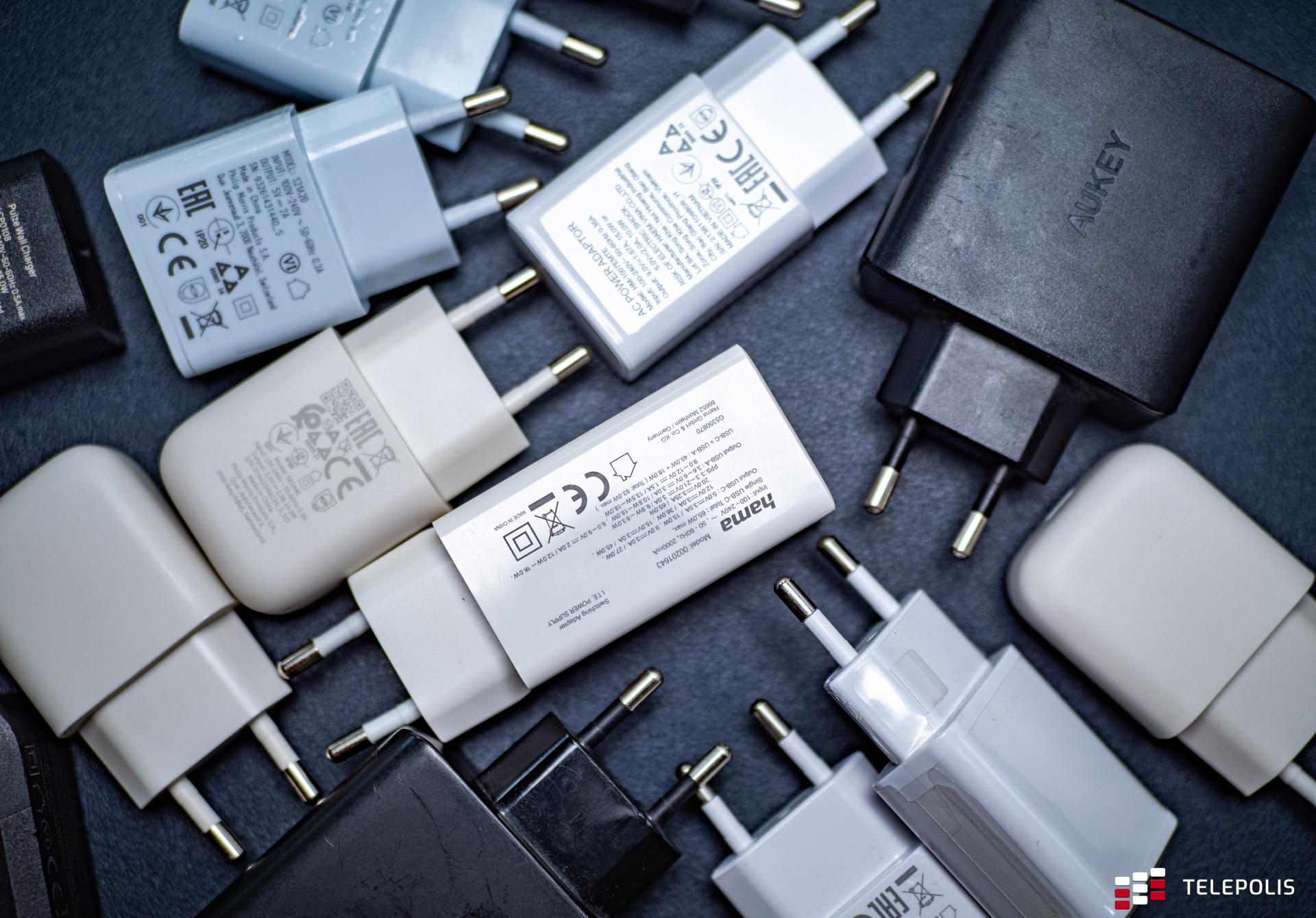
The EU is taking charge of chargers. A new obligation from December
The EU RED Directive will soon enter into force, which not only introduces the obligation to sell electronic devices with a universal USB-C charging port, but will also, to some extent, force the sale of devices without a charger included. What exactly does this mean for customers? We asked the source, i.e. the producers themselves.
Exactly On December 7, 2022, the European Union published the RED Directive. It introduces an obligation to offer universal USB-C charging port in most electronic devices, including primarily in smartphones, tablets, consoles, book readers, keyboards, mice, speakers, digital cameras, navigations and headphones. Member countries, including Poland, had time to implement the new regulations until December 28, 2023. This happened in our country thanks to the adoption of the Electronic Communications Act.
But the regulations will actually come into force only from December 28, 2024. It is true that many manufacturers have long adapted to them, including Apple, but all new devices that will be released on the market after this date must have a USB-C connector. This applies to all the categories mentioned above, a from April 28, 2026, it will also affect the laptop market.
One charger to rule them all
The idea behind the new regulations is clear. European Union the idea is for consumers to have access to one universal charging socket. This way they won’t have to switch between different standards. One charger will be enough to charge almost everything. But is it really? Well, not entirely.
All devices that support fast charging will now have the same charging speed. This way, users will be able to charge them just as quickly with a compatible charger.
– we read on the website of the European Parliament.
The problem is that the charging connector is one thing, and the standard and speed of fast charging are another. While the port will be the same in all devices, the method in which the fast charging technique will be implemented will not necessarily be the case. It has long been known that manufacturers use various solutions. We have QuickCharge, SuperCharge in Huawei phones, PowerDelivery or Thunder Charge in Infinix devices.
Therefore, words about the possibility of charging all devices equally quickly with one charger are just pure nonsense. There will be no agreement on a single standard here for a long time.
A phone without a charger? Mandatory
The RED directive introduces not only: obligation to offer a universal USB-C charging port. From her records we also learn that If the manufacturer of a given device offers it in a version with a charger, it must also sell a version without a chargeri. He talks about it Article 3a, paragraph 1which reads:
Where an economic operator offers consumers and other end-users the opportunity to purchase radio equipment as referred to in Article 3 section 4, together with the charging device, the economic operator shall also offer consumers and other end-users the possibility of purchasing that radio equipment without the charging device.
Moreover, the directive requires information about whether the charger is included in the set presented on the packaging in the form of a graphic pictogramwhich is user-friendly and easily accessible. Manufacturers can choose either information directly on the box or a sticker placed on the packaging. The pictogram must be clearly visible and legible. However, in the case of distance sales, i.e. via the Internet, information about the presence (or not) of the charger must be placed near the price indication.
In addition to the pictogram itself, it has also become mandatory to provide information about the maximum allowable charging power range, which it reminds people of Rami Khalife, Senior PR & Marketing Specialist at Motorola Mobility Poland: :
(…) We have already introduced the graphic markings required by law. They indicate whether the charger is available in the set, but also – in accordance with the requirements of the EU Directive – inform about the minimum and maximum allowable power range (W) for charging the device. In practice, the first value corresponds to a regular, universal USB charger, while the second one is used for fast charging technology – for example, TurboPower™ 125 W technology.
And in fact, appropriate markings appear on the packaging of devices introduced this year. We see them on all Samsung, Motorola, Google and Apple boxes. Below are some examples.
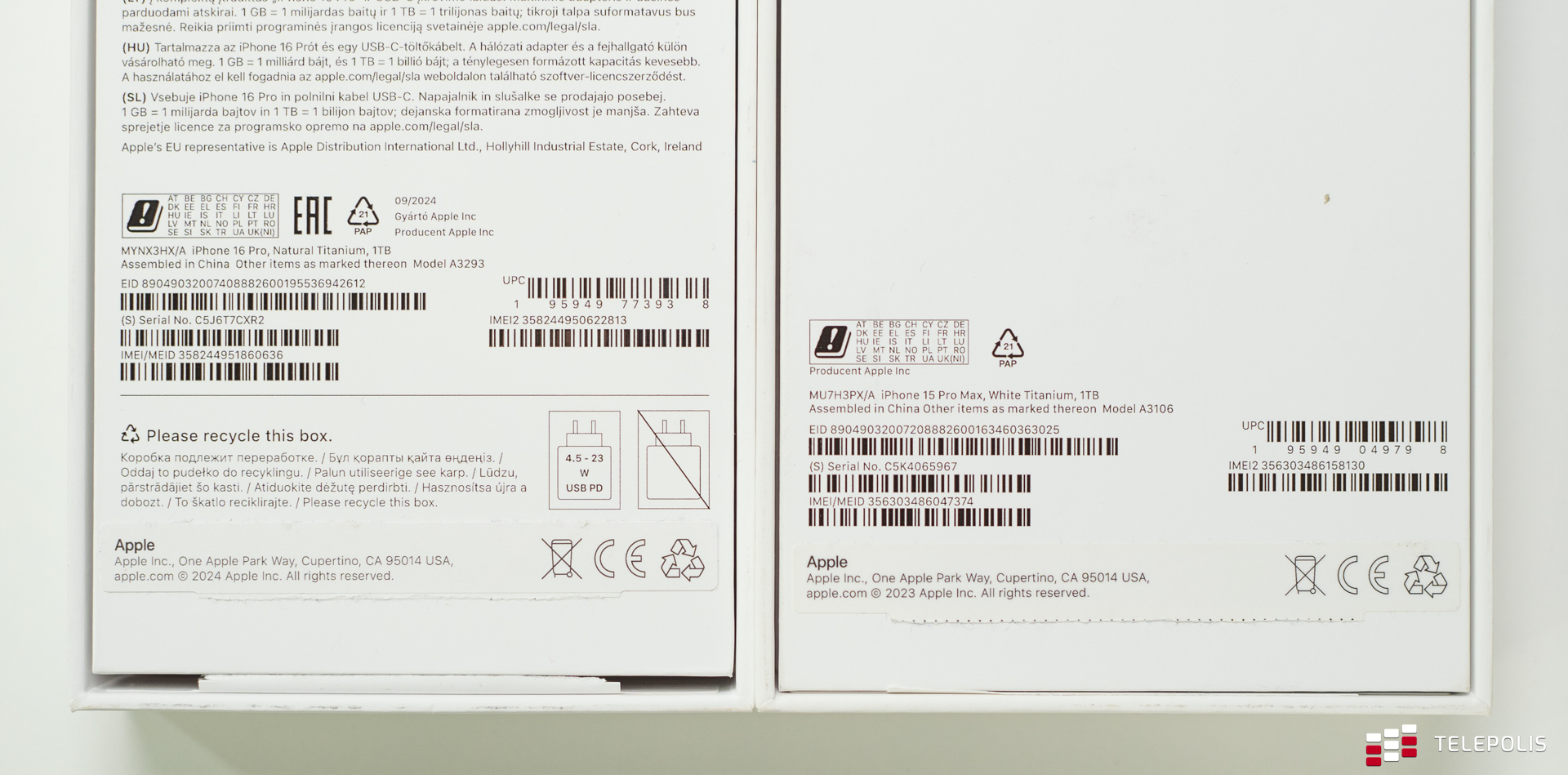
Apple iPhone 16 Pro box (left) and Apple iPhone 15 Pro Max (right)
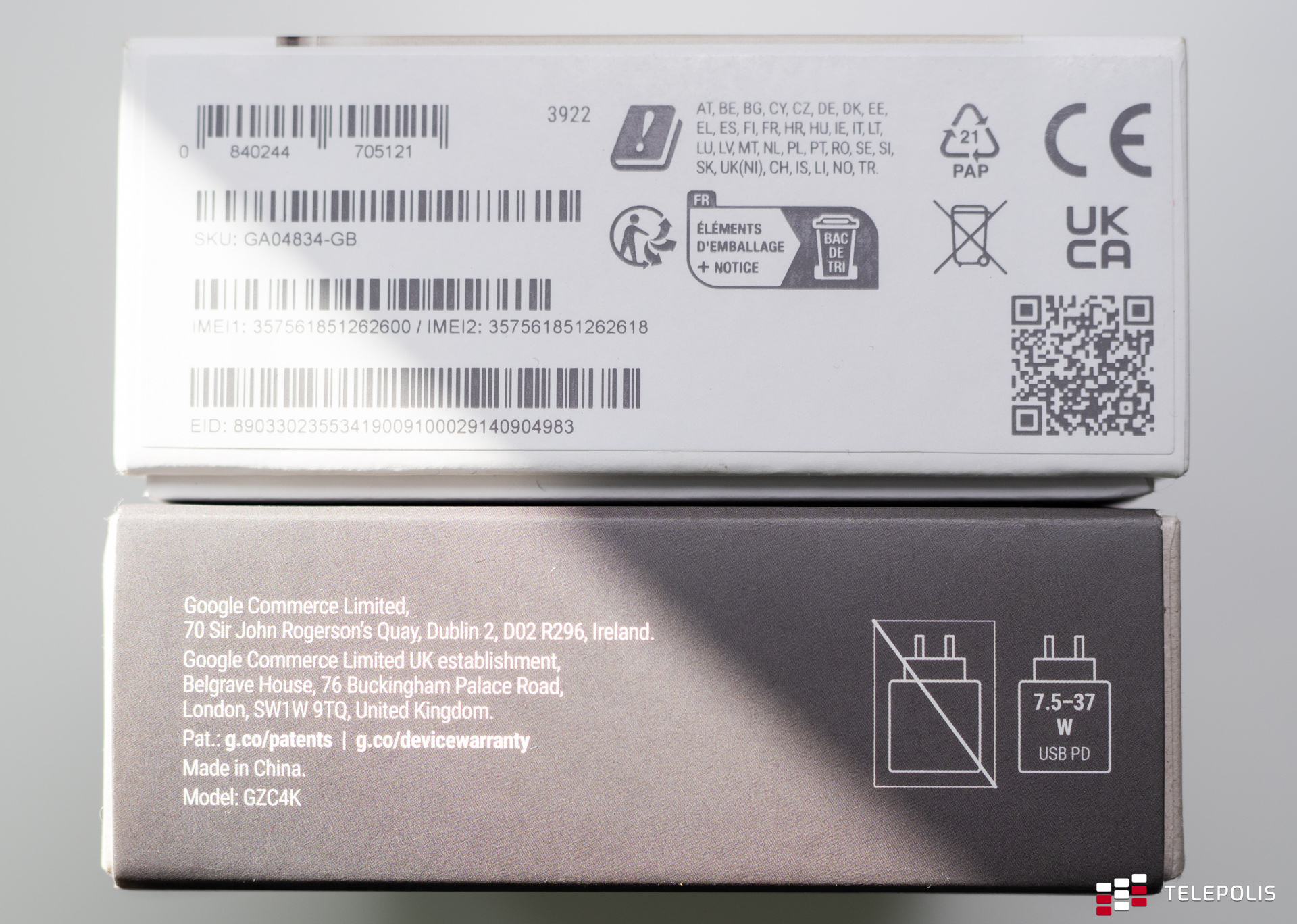
Google Pixel 8 Pro box (top) and Google Pixel 9 Pro XL (bottom)
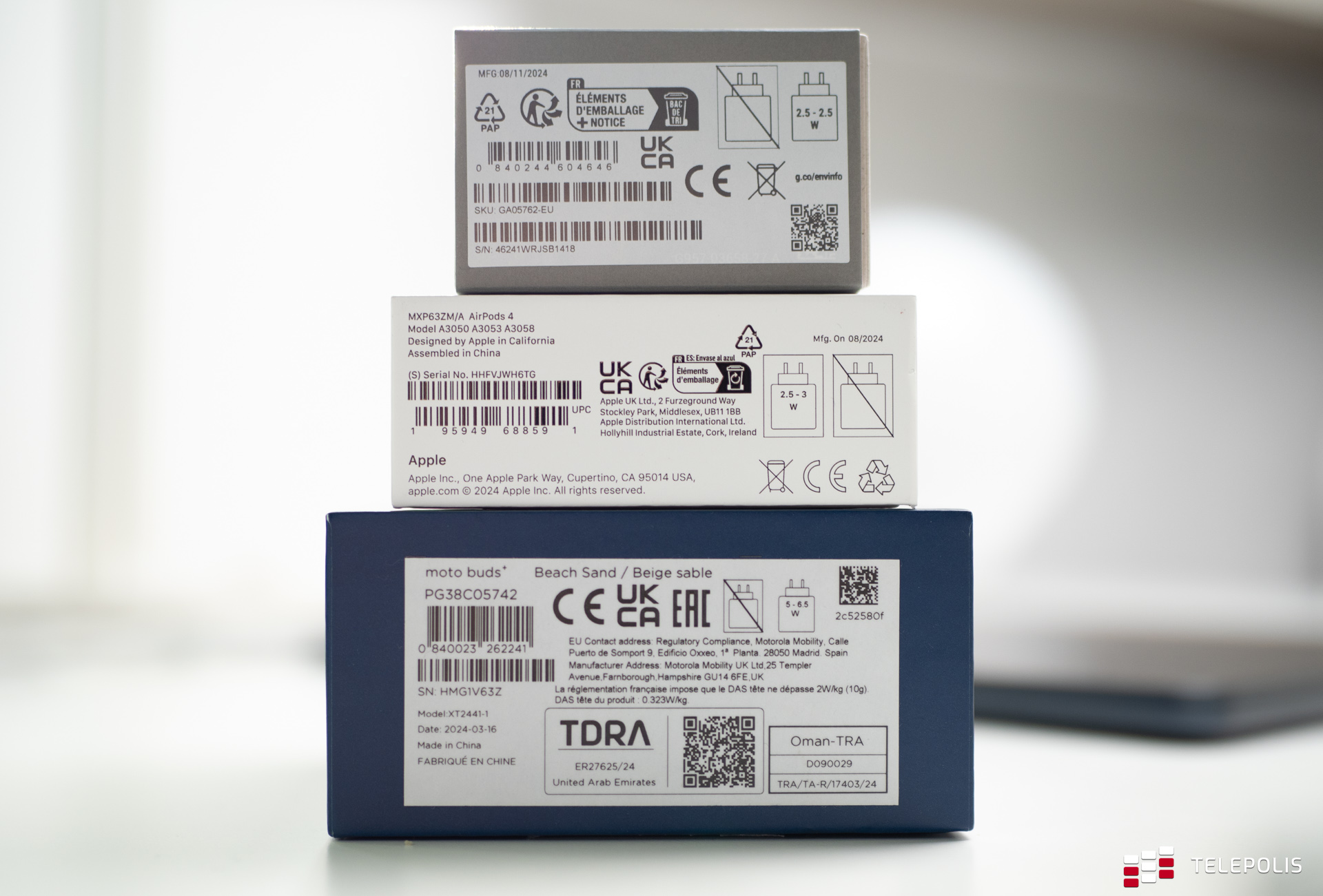
The producers’ preparations are also visible, among others: on the headphone boxes, from the top Google Pixel Buds Pro 2, Apple AirPods 4 and Moto Buds+
Operators are still waiting for a detailed interpretation for one of the scenarios
It should be noted, however, that although the EU directive clearly specifies the obligation to sell devices in a version without a charger, when the offer includes a variant with a charger, Orange and Play claim that they are still waiting for the interpretation of the regulations.
Orange Polska always operates in accordance with applicable law and, of course, we will adapt to new requirements. We are currently waiting for a detailed interpretation of the provisions regarding the rules for offering models with and without chargers in stores at the same time. After receiving it, we will be able to provide more precise details about our further steps.
– says Wojciech Jabczyński, spokesman for Orange Polska, in an interview with TELEPOLIS.PL.
He speaks in a similar tone Play Press Office: :
The obligation to offer electronic equipment with or without a charger, in order to limit the production of e-waste, is at the stage of consultation with the Ministry of Digitization. We are waiting for the interpretation of the regulations. When we receive a response, we will adapt our offer to the interpretation.
The Ministry of Digitization does not agree with this opinion, claiming that no consultations on this matter are being conducted, and the regulations are clearly defined in the Electronic Communications Act and are fully consistent with the EU directive.
These issues have already been regulated in the Electronic Communications Act, adopted by the Sejm on July 12, 2023 (Journal of Laws, item 1221). Pursuant to Art. 278 section 2 of this Act, if a company sells radio devices with a charger, it must also offer these devices without a charger. Information about whether a charger is included with the radio device must be placed on the packaging in a visible and legible way – in the form of a pictogram or sticker. These regulations will enter into force on December 28, 2024.
– the Ministry of Digitization responds to us.
In practice, we can expect that manufacturers will approach this issue in the cheapest way. So most devices introduced after December 28, 2024 will be sold without chargers included. This will be the simplest solution for them. At the same time, the phones should be a bit cheaper, which is what he says in his interview with us, among others Oppo Polska Press Office: :
OPPO is fully prepared to meet EU requirements regarding uniform charging via USB-C and the possibility of purchasing phones without a charger. We already offer our customers smartphone models without a charger included, with the option to purchase it separately, according to the individual needs of users. We try to make the offer as transparent as possible for consumers and to adapt to new regulations, which contributes to the reduction of electronic waste.
Regarding the price issue, purchasing a phone without a charger naturally means a lower cost for the customer. Including a charger in the set generates additional expenses – not only related to the device itself, but also to the production process. Larger packaging, the need for additional documentation and higher transport costs resulting from greater weight are factors that increase the final price of the product. Eliminating these elements translates into savings for the manufacturer, which allows it to offer more competitive prices on the market.
However, Oppo’s communication optimism is cooling down a bit Rami Khalifa from Motorola:
The charger is just one of many elements that determine the price of the device on the store shelf. This is certainly not a dominant factor, as shown by the market practices of other mobile brands, which abandoned including chargers in sales kits even before this practice became the subject of legal regulations from the EU.
In the case of the mobile market, price changes usually occur when new device models are introduced for sale. Therefore, removing the charger from the set has little impact on the price of the new smartphone.
Just note, the law does not apply retroactively. The regulation only applies to new equipment
It is worth emphasizing once again that RED does not apply to devices that were placed on the market before the regulations came into force. Thus, Nintendo Switch will suddenly no longer have to be offered in a version without a charger. However, this will apply all devices put on sale after December 28, 2024i.e. Nintendo Switch 2, which is scheduled to debut next year, in theory should be offered in two variants: with and without a charger… or only without a charger.
The European Parliament estimates that the introduction of a single charging port will allow consumers to save up to EUR 250 million annually on the purchase of unnecessary chargers. It will also contribute to reducing the amount of e-waste, as unused chargers account for as many as 11,000. tons of electronic waste, in the European Union alone.
We also asked manufacturers about their plans for educational activities that would explain to customers the reasons for the lack of chargers. However, as Motorola’s press office rightly suggests, the ball should be in the regulator’s court:
We will consider such actions, but first we want to research the market and assess whether there is such a need among our customers. Informing about legal changes taking place in the EU is the prerogative of the regulator itself.
Our editorial staff remains to remove the lack of a charger from the list of defects in the equipment tests. Now it’s the new standard.
UPDATE: The text has been updated with a statement from the Ministry of Digitization, which denies the claims of Polish telecoms. You can read more about it in the text: “The government explains Polish telecoms. It’s about chargers.”


