
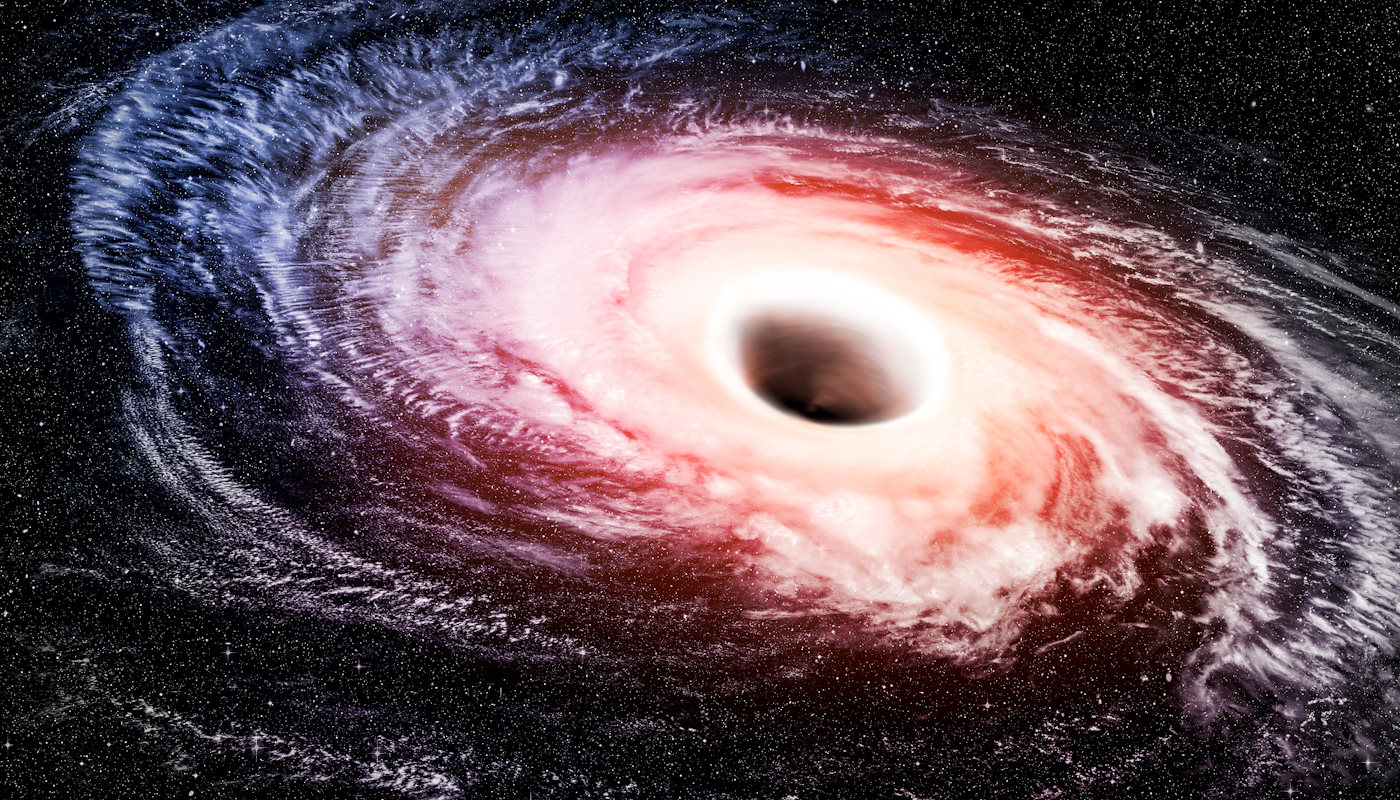
This is the first time we will see a black hole in this way. A breakthrough mission
Space monsters or the key to the secrets of the universe?
Black holes have terrible PR. They are usually depicted as monstrous objects that absorb everything that gets in their way. But now astronomers will capture them on film for the first time and try to shed a completely different light on them.
The Event Horizon Telescope (EHT) – a global network of 12 radio telescopes spread from Antarctica to Spain and Korea – in March and April will shoot moving images of the supermassive black hole at the center of the Messier 87 galaxy. This is the same black hole whose first-ever image EHT showed the world in 2019. Now scientists want to record the spinning disk of material at the edge of the event horizon – the boundary beyond which nothing can escape. Even the light.
“This film campaign is a total revolution. And not only because it is extremely demanding from the technical side, but above all because with its help we will extremely accelerate the development of science,” says Prof. Sera Markoff, newly appointed 17th Plumian Professor of Astronomy at the University of Cambridge and one of the key leaders of the EHT consortium. This is one of the oldest professorial positions in the world, established in 1704 by Thomas Plume, and its statutes were co-created by Isaac Newton.
Markoff emphasizes that black holes unfairly have a bad reputation. “Black holes have a bad reputation as those evil vacuum cleaners that suck everything in. For me, they represent the limits of our understanding of the universe and they never cease to fascinate me. In fact, they play a very important role in the ecosystem of space.”
The sequence of images of the M87 black hole will be created over two months – as the Earth rotates, different telescopes will capture the black hole in their lenses at different times, and thus its complete image will be created every three days. The scale of this object is unimaginable – the black hole’s mass is equivalent to 6 billion Suns, and its size is equivalent to the entire Solar System. Paradoxically, it is these gigantic dimensions that make the black hole move so slowly that it is possible to piece together a movie from it frame by frame.
What’s the point of all this? Measuring the black hole’s rotation speed will help determine how these behemoths grew to their size – whether by “collecting” material (which leads to rapid spinning) or by merging with other black holes (which slows them down). The film may also explain how black hole jets are formed – giant streams of gas ejected outside the galaxy that inhibit the formation of new stars and shape the evolution of entire galaxies.
“M87 throws out these huge jets that pierce the entire galaxy. They can change the entire way the galaxy and even the surrounding galaxies are shaped,” explains Markoff.
However, we will have to wait for the results. The huge amount of data requires physical transportation of hard drives from Antarctica to Germany and the USA – and this is only possible in the Antarctic summer.


