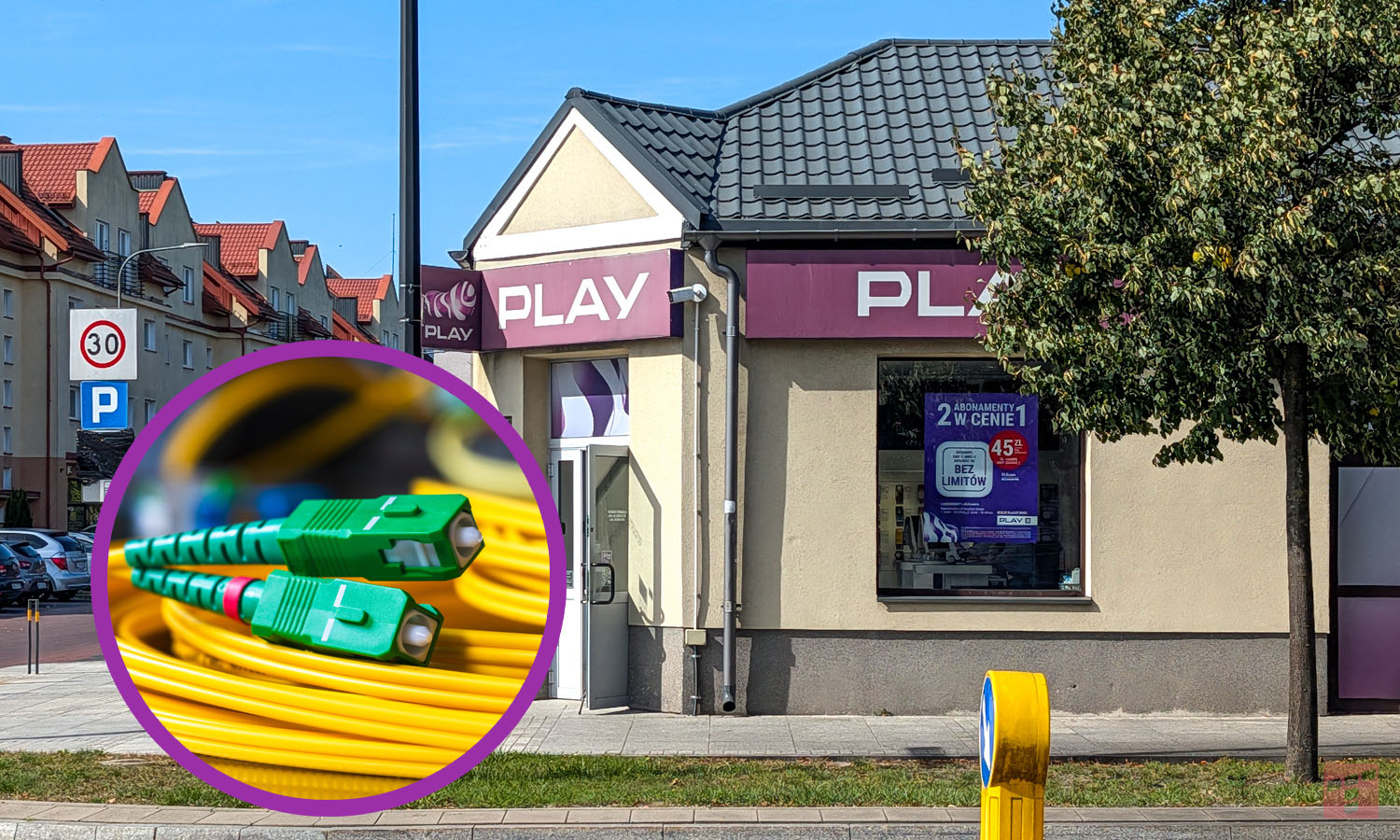
Watch out for fiber optics at Play. You may not get what you expect
Fiber optic in name only
A reader of the TELEPOLIS.PL portal concluded a contract with Play for a product called “Fiber-optic Internet up to 300 Mb/s”. The documents in this matter were signed in September 2025 in the purple operator’s showroom. The subscriber was convinced that a classic fiber optic cable was connected to her premises. However, the network installation technician installed a coaxial cable in the apartment.
The technology used in this case is a hybrid HFC network. In such systems, optical fiber is connected to the residential building itself, and the signal reaches individual apartments via coaxial cables. The woman indicates that she was not informed about this when signing the documents.

Fragment of the contract with Play
According to the information I managed to find, the telecommunications operator is obliged to provide the customer with the type of technology by which the Internet access service will be provided. If it is to be a hybrid HFC service, this should be clearly indicated in the contract or other documents. To confirm this, I sent questions to the Office of Electronic Communications. UKE’s response below.
Including in contracts and providing clear, understandable and comprehensive information to users regarding the service provided and indicating data on the level of services that the consumer can expect is one of the basic information principles that service providers should follow.
To determine what information internet service providers should provide to consumers, the provisions of Regulation 2015/21201 and the Electronic Communications Act are key.
The provisions of Regulation 2015/2120 and the requirements specified in Art. 4 section 1 concern the content of each contract for the provision of Internet access services. There is no doubt that Internet service providers should provide information regarding the services provided in a clear and understandable manner, which must be accurate and up-to-date. Furthermore, it should be emphasized that this information should be relevant to end-users, i.e. be relevant, unambiguous and presented in a useful way. Additionally, it should be noted that the information should not create an incorrect or misleading impression about the service provided to a given user.
The above is also very important for users’ ability to compare offers, so that the comparison can show differences and similarities.
Moreover, it should be noted that in accordance with Art. 285 of the Electronic Communications Act, before concluding a contract with the consumer for the provision of electronic communication services, the provider of electronic communication services provides the consumer with the information required by law (so-called pre-contractual information). Pursuant to the provisions of the Act, pre-contractual information specifies, among others: the main characteristics of each service, including any minimum service quality levels and, in the case of services other than internet access services, specific guaranteed quality parameters, or a statement that there are no minimum service quality levels.
No device from the regulations
The regulations for the provision of Play telecommunications services mention the ONT optical terminal. This device is responsible for the conversion of the light signal and is characteristic of fully fiber-optic FTTH networks. The reader received a cable modem instead. In the contract itself, the section regarding ONT equipment was left empty.
The Play network responded to the allegations in correspondence with the editorial office of TELEPOLIS.PL. The company’s press office informed that the type of equipment provided depends on the type of network. The operator’s representatives refer to the provisions of the regulations. The document mentions the provision of an “ONT and/or Device”, which gives the supplier flexibility in installation.
The law requires parameters to be provided
EU regulations impose certain information obligations on telecommunications operators. They are included in Regulation 2015/2120, which sets out the rules for access to the open Internet. Each provider must clearly indicate in the contract the exact parameters of the stationary service. The document should specify the minimum, normally available and maximum speeds.
The need to provide this type of information was confirmed by the Office of Competition and Consumer Protection. In response to our questions, the Office of Competition and Consumer Protection wrote that:
the rules for the provision of internet access services are regulated by Regulation (EU) 2015/2120 of the European Parliament and of the Council, which introduces open internet standards throughout the European Union. Pursuant to Art. 4 of this act, the contract covering the internet access service should specify in a clear and understandable way, among others: the minimum, typically available, maximum and declared download and upload speeds for fixed networks and, for mobile networks, the estimated maximum and declared speeds.
It should also be remembered that failure to provide important information or misleading the consumer may constitute an unfair market practice and, consequently, violate the collective interests of consumers.
We received a similar position from the Office of Electronic Communications. In response to a question about link parameters, Agnieszka Sobucka from UKE wrote:
Yes, such an obligation results directly from Regulation 2015/2120. Pursuant to Art. 4 section 1 letter d of Regulation 2015/2120, in the case of an Internet access service, the contract must contain a clear and understandable explanation regarding the minimum, normally available, maximum and declared speeds for downloading and uploading data for Internet access services in the case of fixed networks or regarding the estimated maximum and declared speeds for downloading and uploading data for Internet access services in the case of mobile networks.
Taking the above into account, the mere indication of the speed “up to 300 Mb/s” means only the maximum speed, and therefore may be inconsistent with Art. 4 section 1 letter d Regulation 2015/2120.
It is also worth pointing out that in order to grant rights to end users, the speed values required in Art. 4 section 1 letter d) Regulation 2015/2120 should be specified in the contract and published in such a way that it can be verified and used to identify any discrepancies between actual performance and what was agreed in the contract.
The Play client contract included only the maximum speed value. It is among the photos of the documents we received from her.

Fragment of the contract with Play
Play: the client was informed about everything
A TELEPOLIS.PL reader asked us to intervene in the above-mentioned case. We first took steps to the Play press office, asking for clarification on the matter. We asked about three things: lack of information about the Internet connection technology, lack of a device indicated in the regulations and lack of mandatory connection parameters (minimum and usually available speeds).
Regarding the lack of an ONT device, I have already quoted Play’s answer earlier. As for the information gaps raised by the Play client, we received the following response:
In accordance with formal requirements, we present information about the technical parameters of the Internet service. The Play client can find such information in:
1. Basic Terms and Conditions of the Contract (PWU) – a concise summary of the terms and conditions of the contract,
2. pre-contractual information – as part of the price list of the offer ordered by the customer.
However, our reader claims that she did not receive the information mentioned by the representative of the purple operator. The woman indicates that the advisor at the salon in Kutno and the technician installing the service did not provide her with data on the use of HFC technology. The contract only includes a provision about fiber-optic Internet. The subscriber emphasizes that there is no ONT optical terminal installed in her apartment. This device is used exclusively in fiber optic technology.
The client also accuses the operator of errors in responses to the complaint. The network’s representatives refer to provisions that are not included in the documents signed by it. The woman finds the supplier’s explanation inconsistent with the facts.
The Operator agrees to terminate the contract
The subscriber intervened many times in the Play customer service department. She accused the company of intentional misleading at the stage of selling the offer and installing the service. The purple operator initially rejected all complaints, claiming that the hybrid service meets European ETSI quality standards. Play representatives assured that the speeds specified in the contract are realistically achievable in HFC networks.
The case was brought to the District Consumer Ombudsman in Kutno. After the spokesman’s intervention, the operator changed its position and offered to end the dispute amicably. The Play network proposed to terminate the Internet contract without charging additional costs. However, subscription fees charged for the previously used period are not subject to cancellation.

A letter from Play ending the dispute
Marketing versus reality
The case of a TELEPOLIS.PL reader described in this article shows that the name on a leaflet is often just an element of marketing. Operators are able to sell older technology based on copper cables (DOCSIS) under the slogan “fiber optic”. Therefore, it is worth asking about the technical details of the installation before signing the documents.
This story also proves that the intervention of a consumer ombudsman brings results in a confrontation with a large corporation. Although Play did not officially acknowledge its guilt, it ultimately allowed the client to leave without paying contractual penalties.
However, the question still remains: does Play sell something other than what it promises? We only have reports from two sides that present different positions on this topic. In my humble opinion, this is definitely a matter that should be thoroughly investigated by the institutions responsible for this purpose.