
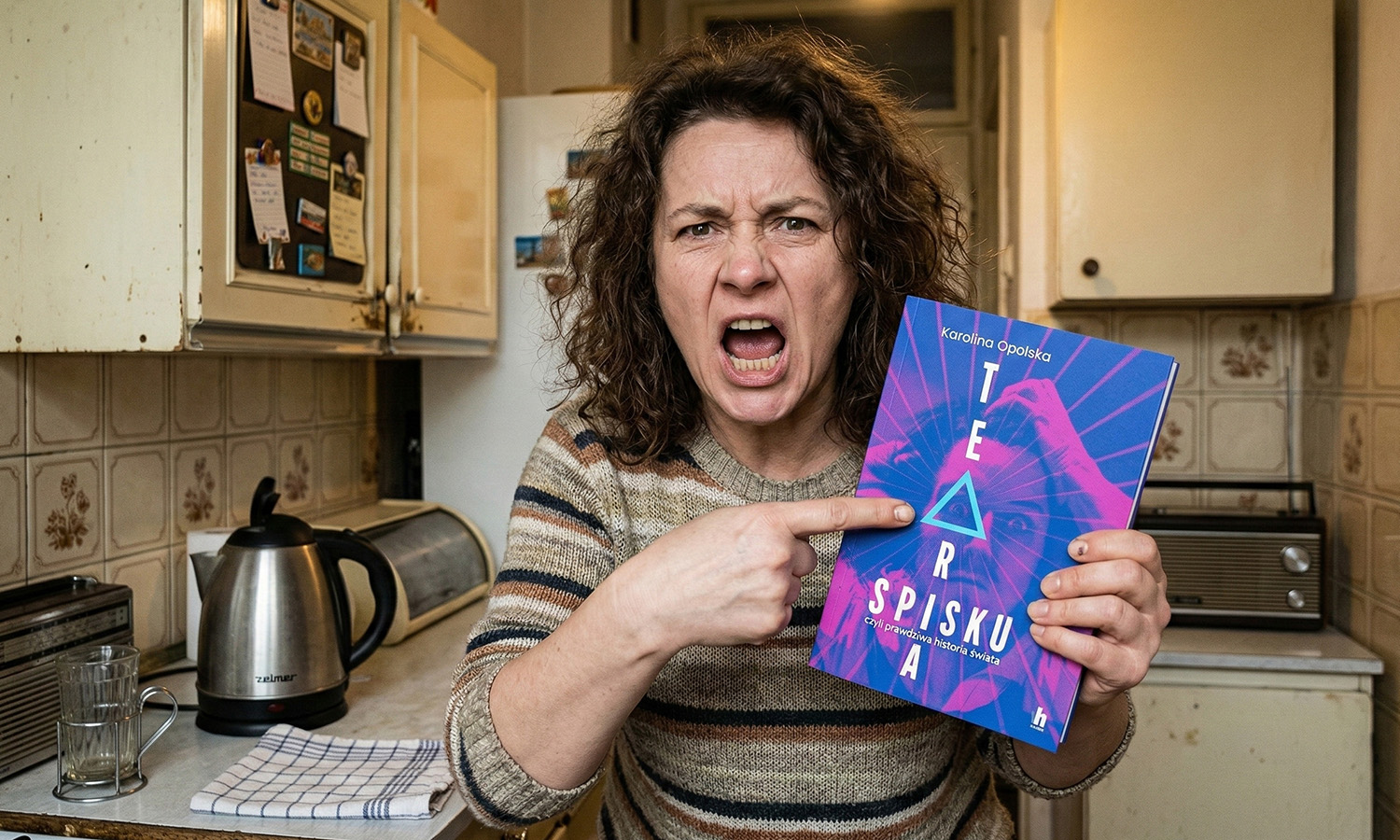
Conspiracy Theory withdrawn from sale. Macao and after Makal
This publishing drama showed us several things: book authors can use AI tools thoughtlessly, and publishers do not have to check it. However, this attitude quickly backfires because there is always someone who will verify the material. Covering yourself with technical errors and hate is a poor narrative, and trying to wait out the crisis leads nowhere.
The question is, will others remember this lesson?
AI hallucinations, i.e. technical error
A short introduction for people who do not know or remember the topic. At the end of last year, Karolina Opolska’s book became famous. The latter is currently one of the faces of TVP, and at Civitas University she is the deputy head of the Department of Journalism and New Media. He is a person with extensive experience in the domestic media. But let’s focus on publication.
The book “Conspiracy Theory, or the True History of the World” quickly turned out to be a disgrace. The author was accused of making up footnotes and referring to non-existent books. Importantly, she could have done it unconsciously, because she probably used AI tools in her work. The matter was publicized on social media by Artur Wójcik, who presents himself as a “historian, popularizer and podcaster, debunker of myths, describer of Shuria and all kinds of pseudoscience.” Wójcik began his first entry on this topic with the words: “I haven’t felt such embarrassment for a long time.”
This story could be coming to an end at this point. The author and the publishing house had a chance to say how things are and, for example, admit that AI hallucinations can be dangerous, and they fell victim to them (at their own request). However, a different path was chosen. It was decided to convince everyone that referring to non-existent books is the result of… a technical error.
This is the narrative adopted by the Harde publishing house behind the publication, which is part of the ZPR Media Group. To make things even funnier: the publisher declared in a statement that “at no stage was the book written or co-created by AI tools.” How was this found? This has not been explained yet. But there were no objections to Karolina Opolska’s work. In fact, it was written that she showed exceptional reliability.
Errata will be available in a few days. That is, never
The scandal spread more and more widely, the author was criticized for further errors in her book, which prompted her to announce that “an errata from the publishing house will be published soon, which will explain everything.” Its preparation was supposed to take several days, and it happened in November. Days, then weeks and months passed, but the errata was not published. Many signs in heaven and on earth indicate that the author and the publishing house have decided to wait the matter out. However, this tactic proved ineffective.
At the beginning of March, I wrote that I decided to refresh the matter. I was unable to contact Karolina Opolska. I had better luck with the publishing house whose representative replied to me:
Currently, I do not have any new information on this matter, if new information appears, HARDE Publishing House will issue a statement that will be sent to the media.
And it should be noted that it was not an empty promise. New information has emerged in the case and I have received another statement in my e-mail. It reads as follows:
HARDE Publishing House and Karolina Opolska, author of the book “Conspiracy Theory, or the True History of the World”, made a joint decision to withdraw the book from sale.
The author retains full rights to the book, and any decisions regarding its possible re-publication will be made by her independently, in accordance with her further professional and publishing plans.
The publishing house is silent. Employers are preparing a position
I asked the publisher’s representative to expand on the message, I wanted to find out, for example, whether customers who purchased the book can request a refund. Unfortunately, the answer was eloquent silence. My interlocutor ultimately repeated that everything they had to say was already in the statement.
I would bet money that students would learn from this example how not to solve problems. Who knows, maybe Civitas University employees will prepare a lecture on this topic? For now, I have asked the university to comment on the whole matter. It reads as follows:
According to the information provided by Karolina Opolska, the decision to withdraw the book “Conspiracy Theory, or the True History of the World” was made jointly by the author and the publishing house. Civitas University was not a party to the publishing process or participated in the preparation of the publication.
Mrs. Karolina Opolska is a lecturer at Civitas University, highly rated by students and colleagues for her teaching activities. Her work at the university is independent of journalistic and publishing activities carried out outside its structures. At the moment, we see no grounds to change the form of cooperation. At the same time, we treat every situation of public interest seriously and rely on official, confirmed information provided by the parties involved.
As a university, we attach great importance to the reliability of journalism and the responsible use of tools, including AI tools – these are also topics present in the university’s teaching programs. We teach critical thinking, responsibility and reliability in journalistic work. These are the values that we pass on to students regardless of individual situations related to activities outside the university
One may get the impression that this case has become a banana peel for another institution. Because I don’t know how you can argue that you are learning “critical thinking, responsibility and reliability in journalistic work” and at the same time ignore the actions of editor Karolina Opolska, explaining that they are her activities outside the university. Oddity.
I turned to TVP with a similar request. In this case, the message was short:
Telewizja Polska is not a party to Karolina Opolska’s contract with Harde Publishing House and did not participate in the creation of her book
The signal for the employees of TVP and Civitas University is quite clear: after hours you can really talk, we don’t care, the door will always be open…
What does Karolina Opolska herself say about this? Although the author did not comment on the merits of the case, she posted the following comment on Facebook:
Since yesterday, I’ve read about myself that I’m trash, that I should go back to the brothel, that I should shoot myself (hang, drown – whatever color you choose!), that someone should beat me up in a dark alley, that I should go to jail, that my only future is only fans. A lot of considerations about what my private parts look like and whether I have tattooed anything there. And besides, the classic fact that I’m ugly, old and fat… what’s worse – my relatives get hit. And all this because the book was withdrawn from sale. Really? Is this what the debate is supposed to look like? And no, I am not “making myself a victim of hate”, I am describing what happens to me and I leave it to you to decide whether it should look like this
The answer is obvious: this is not how it should be. However, one can comment similarly on the actions of Karolina Opolska and the Harde publishing house in this matter.
The whistleblower approaches the matter with pessimism
The already mentioned Artur Wójcik, who publicized the whole matter, shared his opinion. I asked him, among other things: whether he is satisfied with the way Karolina Opolska and the publishing house are trying to close the case.
It’s hard to talk about any satisfaction here, because the whole situation is strange to say the least. The author and the publishing house have been proven to have used artificial intelligence to create the publication. Despite this, both the author and the publishing house maintained that AI was not used at any stage. The preparation of an errata for the book was announced, although it was known from the beginning that it would be a risky task. The scale of errors and distortions is so large that the publication should basically be rewritten. Now it turns out that the recipients were also misled regarding the errata. The situation shows that the creators of this “work” disregard their readers, i.e. customers who buy their products. From the very beginning it was necessary to apologize, admit the mistake and withdraw the print from sale. This was what decency demanded
I also asked the historian who was more responsible for this undoubted publishing failure:
There is no single main culprit here. Both the author and the publishing house made cardinal mistakes. If Opolska used AI when writing the book, she should clearly state it. If, however, this was not the case, the editors should have noticed the problem; the errors in the publication are so obvious that a warning light should have gone off for any editor with even minimal experience. In such a situation, it was necessary to conduct a thorough conversation with the author and decide whether the book should be published at all. As you can see, Harde Publishing House is at an embarrassingly low level since such errors made it through the editorial process
Artur Wójcik also described the way Karolina Opolska tried to solve the problem before the scandal broke out. In his opinion, these actions did not look very professional:
This is surprising behavior for a journalist who declares such extensive professional experience
Finally, I asked my interlocutor whether authors and publishers would draw any conclusions from this lesson. Unfortunately, he didn’t have good news for us. In his opinion, reliability will be lost in favor of accelerating processes, which is provided by AI tools. Because time is money. And although Wójcik has nothing against using this type of solutions, he appeals to use them wisely.


