
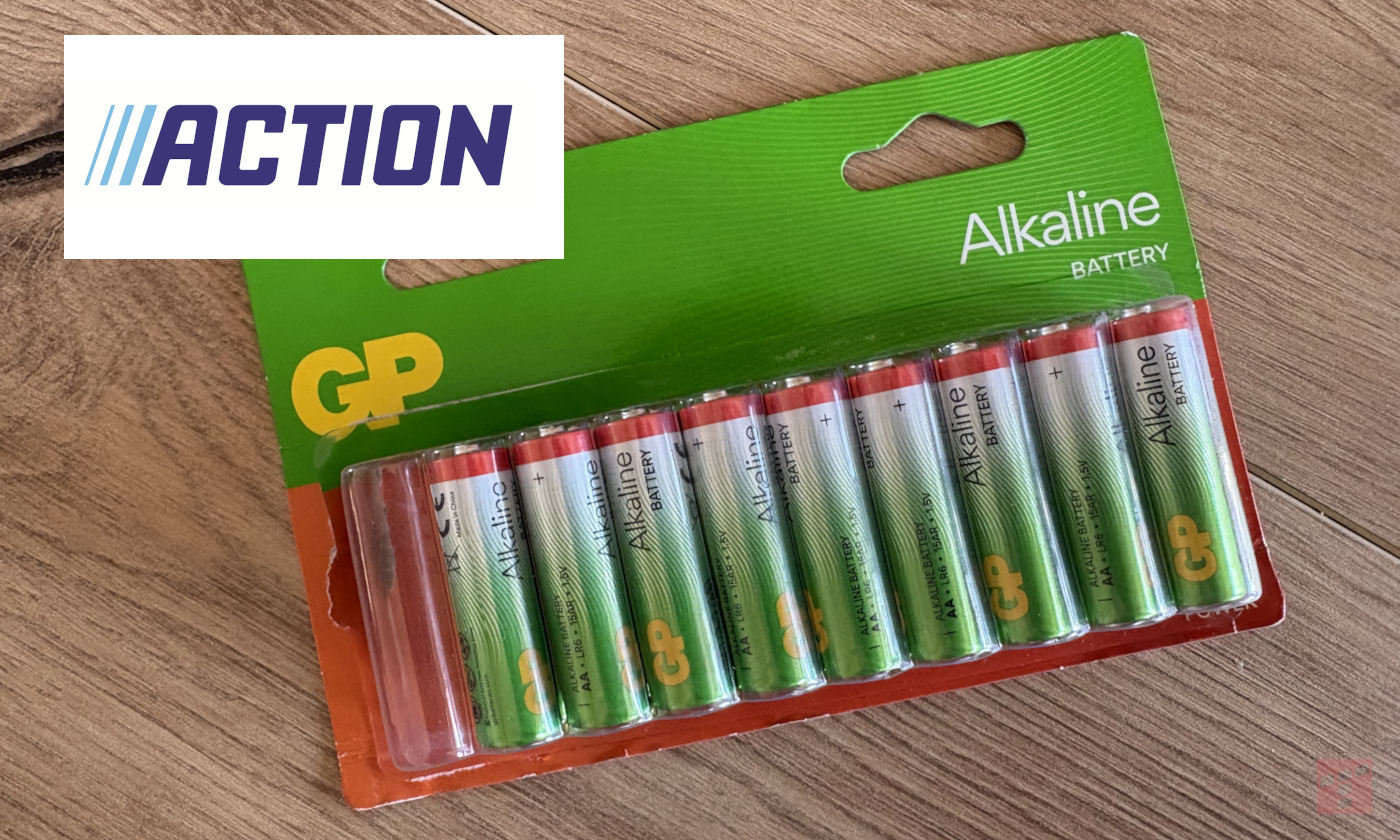
At Action, they cost 87 cents each, and I tested them
This gives us 0.87 cents per item. This is a price associated with zinc rather than alkaline batteries. Questions may arise: do such cheap batteries make any sense at all? I decided to check it out with my trusty dummy load. Of course, it is not exactly the same pack of batteries as with Action, because I have 20, not 30 pieces. However, these are exactly the same batteries.
Alkaline GP batteries from Action after testing
I performed two tests for them: loads of 100 mA and 1 A. To check how they cope with medium and very high loads. In fact, we are mainly interested in two parameters: time and delivered power. I set the discharge threshold to 0.9 V. Below this level, the battery is practically useless for most applications. Additionally, discharging this type of battery too deeply may lead to its leakage. This threshold can be considered safe.
The first test ended after 22 hours 24 minutes and 46 seconds, giving off 2.75 Wh. Is this a good result? In this test, Energizer Longest Lasting 50% lasted 23 hours, 19 minutes and 7 seconds, giving 2.82 Wh, and Duracell lasted 23 hours, 53 minutes and 50 seconds, giving 2.97 Wh. This result is about 1.5 hours worse than much more expensive batteries. However, in the context of over 22 hours, it does not matter that much, since you can buy these batteries for 0.87 cents each.

What about a heavier load? In the 1A GP test, he achieved 53 minutes and 22 seconds of work, giving 0.96 Wh. And here Energizer did much worse. It lasted only 34 minutes and 29 seconds, emitting 0.62 Wh. In the case of Duracell we have 56 minutes and 45 seconds and they released 1.03 Wh.
As you can see, in the 100 mA tests the results are very comparable, and at 1 A load the GP significantly outperformed the Energizer, approaching the level offered by Duracell. And all this in a battery for PLN 0.87.


